ALGEBRA
Algebra is one of the broad parts of mathematics, together with number theory, geometry and analysis. In its most general form, algebra is the study of mathematical symbols and the rules for manipulating these symbols; it is a unifying thread of almost all of mathematics. As such, it includes everything from elementary equation solving to the study of abstractions such as groups, rings, and fields. The more basic parts of algebra are called elementary algebra; the more abstract parts are called abstract algebra or modern algebra. Elementary algebra is generally considered to be essential for any study of mathematics, science, or engineering, as well as such applications as medicine and economics. Abstract algebra is a major area in advanced mathematics, studied primarily by professional mathematicians.
Elementary algebra differs from arithmetic
in the use of abstractions, such as using letters to stand for numbers
that are either unknown or allowed to take on many values. For example, in  the letter
  is unknown, but the law of inverses can be used to discover its value:
  . In E = mc2, the letters
  and
and  are variables, and the letter
  is a constant,
the speed of light in a vacuum. Algebra gives methods for solving
equations and expressing formulas that are much easier (for those who
know how to use them) than the older method of writing everything out in
words.
is a constant,
the speed of light in a vacuum. Algebra gives methods for solving
equations and expressing formulas that are much easier (for those who
know how to use them) than the older method of writing everything out in
words.
The word algebra is also used in certain specialized ways. A special kind of mathematical object in abstract algebra is called an "algebra", and the word is used, for example, in the phrases linear algebra and algebraic topology.
A mathematician who does research in algebra is called an algebraist.
Algebra began with computations similar to those of arithmetic, with letters standing for numbers.[4] This allowed proofs of properties that are true no matter which numbers are involved. For example, in the quadratic equation

 can be any numbers whatsoever (except that
  cannot be
  ), and the quadratic formula can be used to quickly and easily find the values of the unknown quantity which satisfy the equation. That is to say, to find all the solutions of the equation.
The roots of algebra can be traced to the ancient Babylonian
The quadratic formula expresses the solution of the degree two equation ax2 + bx + c = 0, where a is not zero, in terms of its coefficients a, b and c.

Elementary algebra is the most basic form of algebra. It is taught to students who are presumed to have no knowledge of mathematics beyond the basic principles of arithmetic. In arithmetic, only numbers and their arithmetical operations (such as +, −, ×, ÷) occur. In algebra, numbers are often represented by symbols called variables (such as a, n, x, y or z). This is useful because:It allows the general formulation of arithmetical laws (such as a + b = b + a for all a and b), and thus is the first step to a systematic exploration of the properties of the real number system.It allows the reference to "unknown" numbers, the formulation of equations and the study of how to solve these. (For instance, "Find a number x such that 3x + 1 = 10" or going a bit further "Find a number x such that ax + b = c". This step leads to the conclusion that it is not the nature of the specific numbers that allows us to solve it, but that of the operations involved.)It allows the formulation of functional relationships. (For instance, "If you sell x tickets, then your profit will be 3x − 10 dollars, or f(x) = 3x − 10, where f is the function, and x is the number to which the function is applied".
 Algebraic expression notation:
1 – power (exponent)
2 – coefficient
3 – term
4 – operator
5 – constant term
x y c – variables/constants
POLYNOMIAL
A polynomial is an expression that is the sum of a finite number of non-zero terms, each term consisting of the product of a constant and a finite number of variables raised to whole number powers. For example, x2 + 2x − 3 is a polynomial in the single variable x. A polynomial expression is an expression that may be rewritten as a polynomial, by using commutativity, associativity and distributivity of addition and multiplication. For example, (x − 1)(x + 3) is a polynomial expression, that, properly speaking, is not a polynomial. A polynomial function is a function that is defined by a polynomial, or, equivalently, by a polynomial expression. The two preceding examples define the same polynomial function.
Two important and related problems in algebra are the factorization of polynomials, that is, expressing a given polynomial as a product of other polynomials that can not be factored any further, and the computation of polynomial greatest common divisors. The example polynomial above can be factored as (x − 1)(x + 3). A related class of problems is finding algebraic expressions for the roots of a polynomial in a single variable.
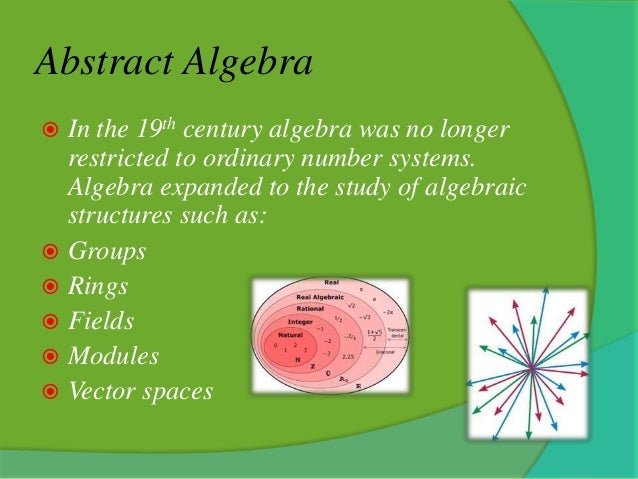
Abstract algebra extends the familiar concepts found in elementary algebra and arithmetic of numbers to more general concepts. Here are listed fundamental concepts in abstract algebra.
Sets: Rather than just considering the different types of numbers, abstract algebra deals with the more general concept of sets: a collection of all objects (called elements) selected by property specific for the set. All collections of the familiar types of numbers are sets. Other examples of sets include the set of all two-by-two matrices, the set of all second-degree polynomials (ax2 + bx + c), the set of all two dimensional vectors in the plane, and the various finite groups such as the cyclic groups, which are the groups of integers modulo n. Set theory is a branch of logic and not technically a branch of algebra.
Binary operations: The notion of addition (+) is abstracted to give a binary operation, ∗ say. The notion of binary operation is meaningless without the set on which the operation is defined. For two elements a and b in a set S, a ∗ b is another element in the set; this condition is called closure. Addition (+), subtraction (−), multiplication (×), and division (÷) can be binary operations when defined on different sets, as are addition and multiplication of matrices, vectors, and polynomials.
Identity elements: The numbers zero and one are abstracted to give the notion of an identity element for an operation. Zero is the identity element for addition and one is the identity element for multiplication. For a general binary operator ∗ the identity element e must satisfy a ∗ e = a and e ∗ a = a, and is necessarily unique, if it exists. This holds for addition as a + 0 = a and 0 + a = a and multiplication a × 1 = a and 1 × a = a. Not all sets and operator combinations have an identity element; for example, the set of positive natural numbers (1, 2, 3, ...) has no identity element for addition.
Inverse elements: The negative numbers give rise to the concept of inverse elements. For addition, the inverse of a is written −a, and for multiplication the inverse is written a−1. A general two-sided inverse element a−1 satisfies the property that a ∗ a−1 = e and a−1 ∗ a = e, where e is the identity element.
Associativity: Addition of integers has a property called associativity. That is, the grouping of the numbers to be added does not affect the sum. For example: (2 + 3) + 4 = 2 + (3 + 4). In general, this becomes (a ∗ b) ∗ c = a ∗ (b ∗ c). This property is shared by most binary operations, but not subtraction or division or octonion multiplication.
Commutativity: Addition and multiplication of real numbers are both commutative. That is, the order of the numbers does not affect the result. For example: 2 + 3 = 3 + 2. In general, this becomes a ∗ b = b ∗ a. This property does not hold for all binary operations. For example, matrix multiplication and quaternion multiplication are both non-commutative.

Algebra in computer programming
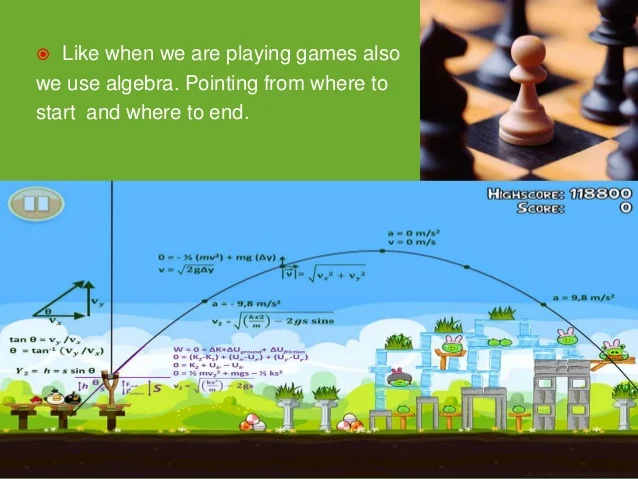
As we have seen, algebra is about recognising general patterns. Rather than looking at the two equations 3x+1=5 and 6x+2=3 as two completely different things, Algebra sees them as being examples of the same general equation ax+b=c. Specific numbers have been replaced by symbols.Computer programming languages, like C++ or Java, work along similar lines. Inside the computer, a character in a computer game is nothing but a string of symbols. The programmer has to know how to present the character in this way. Moreover, he or she only has a limited number of commands to tell the computer what to do with this string. Computer programming is all about representing a specific context, like a game, by abstract symbols. A small set of abstract rules is used to make the symbols interact in the right way. Doing this requires algebra.
Codes
Error Correcting Codes are used in almost all forms of digital storage and communication, from DVD players to satellite communication. The theory and practice of constructing good error correcting codes rely heavily on the abstract notions of finite fields and vector spaces (see e.g. Huffman[1]), and more recently on even deeper and more abstract algebraic concepts like function fields and algebraic curves (Stichtenoth[2]).
Expander Graphs
Expander graphs can be used to design sparse communication networks with very strong connectivity features. "Sparse" means that every node in the network is connected to just a few other nodes; "strong connectivity" means that in order to sever the connection between two substantial pieces of the network you'd have to cut lots of individual connections. Expander graphs are useful also in a variety of algorithms where one needs to simulate "randomness" in a deterministic way.Constructing good expander graphs is hard. The best known constructions rely on very deep results in representation theory, see e.g. Lubotzky
3D Modeling and Animation
Representing rotation in 3D space, particularly when one wants to interpolate between two rotation states as in 3D animation, is usually done using the algebraic concept of quaternions. It's amusing to find chapters on "quaternions" in the user manuals of software such as Maya and 3d studio.Block Designs
In a sense this is a generalization of the "Codes" example. Block designs are very symmetric finite set systems; a nice concrete example to keep in mind is the following little challenge: find a set of 7 triplets of numbers in the range 1..7 such that every pair of numbers in this range belongs to precisely one triplet (look up the Fano Plane).
Such symmetric designs are useful in a variety of real-life contexts such as the design of experiments (it's a good way to choose sample sets without biases) and - - software testing, though I'm not really familiar with how they're used for that.
Once again, constructing block designs relies heavily on tools from abstract algebra, specifically finite fields (especially projective and affine geometries based on finite fields) and finite groups.
Every day life
Formulas are a part of our lives. Whether we drive a car and need to calculate the distance, or need to work out the volume in a milk container, algebraic formulas are used everyday without you even realizing it.Analysis
When it comes to analyzing anything, whether the cost, price or profit of a business you will need to be able to do algebra. Margins need to be set and calculations need to be made to do strategic planning and analyzing is the way to do it.Data entry
What about the entering of any data. Your use of algebraic expressions and the use of equations will be like a corner stone when working with data entry. When working on the computer with spreadsheets you will need algebraic skills to enter, design and plan.Decision making
Decisions like which cell phone provider gives the best contracts to deciding what type of vehicle to buy, you will use algebra to decide which one is the best one. By drawing up a graph and weighing the best option you will get the best value for your money.Interest Rates
How much can you earn on an annual basis with the correct interest rate. How will you know which company gives the best if you can't work out the graphs and understand the percentages. In today's life a good investment is imperative.The formulas of algebra are used every day in real life when distance needs to be determined, volumes in containers need to be figured out and when sale prices need to be calculated. When using a recipe and doubling it or cutting it in half, algebra is used to
Hence algebra is used in various fields

No comments:
Post a Comment